
Bear (2004-2018)
Bear (2004-2018)
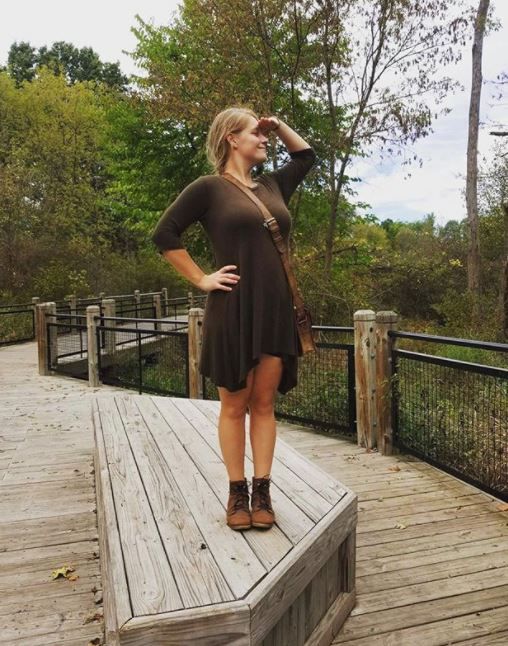
“This is your renewal, this is your regrowth. You may come into this softly or bristling with thorns, beneath the light of the sun or the moon and the stars, so long as you always remember it is never too late to return to the root of your heart and begin again” (Beau Taplin).
Five months. It has been five months since I closed the slim volume of what was to be my great African adventure on this blog. I think I have run from “West of Moon” mostly out of fear that I had nothing more to say. I neglected this space out of shame, that my days substitute teaching, freelance writing, and spending quiet Monday evenings at the barn were too simple for my readers and could do nothing to entice their imaginations or kindle their own dreams of travel and adventure. In fact, I have written almost nothing at all.
Yet the past five months have been a tremendous period of self-growth. While my heart has been roiling with storms of doubt, frustration, and fear, I made the conscious choice to raise my sail and face the tempest, rather than let it drown me. I am learning what it means to be present in life, even the delicate moments that may seem insignificant, for those are often the most powerful reminders that we have been granted this tremendous gift called living.
I am also striving to live with intention. For me, living intentionally looks like making a list of small goals I can achieve throughout my day to demonstrate that I am capable. It looks like vocalizing my appreciation for my parents, my boyfriend, and my closest friends for the love and support they continue to wash over me despite my shortcomings. It looks like actions instead of words, like teaching myself to sketch, practicing yoga, and forming a habit of meditation rather than simply saying I will one day. It looks like facing my fears and writing every dream-laden, raw, and honest thought that inhabits my soul to truly be the writer I claim I am, for how can a writer call herself thus if she is too afraid of writing?
These bits and bobs of my journey in this life, from every moment of effervescent joy to the ones that are bruised and battered, are worthy of exploring. To those who have grown accustomed to my indulgent descriptions of all the wild and wonderful landscapes I have roamed, the changes that are coming to “West of Moon” will surely disappoint. To those whose hearts have been broken, who seek a reassuring voice on their own journey of self-love and acceptance, to those that open their heart to the world as often as they breathe, and those who are merely looking for a lovely story on the simple pleasures of a young life being lived, please read on.
This blog will become more of a digital journal than ever before. I have faced incredible instances of clarity paired hand in hand with intense moments of personal doubt or heartbreak. Yet through it all, I am learning to pay attention to the lessons present in all the moments of living. I am also doing so with a generous and loving support system that I am wholeheartedly thankful for. I believe that love, above all else, is worth sharing, from a love of a soulmate to the love of a parent, to the purest kind of love of all: a true and deep love of oneself. I will begin sharing all of these introspections and scenes of both sorrow and joy here on “West of Moon,” so if this kind of authentic exploration of life intrigues you, I welcome you with all my heart.
At the root of my heart, I am a storyteller, and I will begin again.
A wee look into my time in The Gambia, West Africa. Though this adventure did not quite turn out as expected, I am still immensely grateful for my time spent in this warm, welcoming country.
“It was at this point that Bilbo stopped. Going on from there was the bravest thing he ever did” (The Hobbit by J.R.R. Tolkien).
In The Gambia, everyone and everything exists ndanka ndanka. This adage roughly translates to “slowly slowly” in English from Wolof, the native language of the Wolof people, just one of the ethnic groups that call The Gambia home. Ndanka ndanka embodies Gambian philosophy and inhabits each moment of waking life in that tiny African country: in the way the people doze in the shade of the mango tree to seek respite from the balmy haze, in the way the sun creeps with agonizing slowness over the red earth. Not only this, living ndanka ndanka alongside the Gambian people constitutes the most important lesson I learned during my short time with the Peace Corps.
As one of the Peace Corps language and culture facilitators so poignantly stated, “In America, time owns you. In The Gambia, you own your time.” I believe that, at this uncertain and “lost” moment in my life, these words were the ones I needed to hear the most. They were needed so that I may at long last achieve the clarity and peace of mind I had so desperately been searching for. These words pierced me right down to the marrow of my bones and, married with the awakening I experienced while living in and amongst the Gambian people, helped me with the most difficult decision I have had to make in my life thus far.
On June third I made the decision to terminate my service with the Peace Corps. I recognized that some personal limits cannot be transcended, no matter how fiercely one tries to overcome those limits and escape their comfort zone. I also had the realization that, as a result of my experience in Scotland, I had been pushing so very hard to live a life of full-throttle adventure that I was not truly the master of my time at all, but a slave to living at a pace that I could not sustain. So I made the choice to truly do the bravest thing I have ever done: admitted to myself that even I have weaknesses, and decided that it was best to return home after spending just two weeks in The Gambia.
While looking over my previous post regarding the possibility that I would not be able to serve with the Peace Corps, the following statement I had written caught my attention, due in part to this clarity I have achieved since being in country: “Perhaps what I need to do is simply pull my head out of the clouds and acknowledge that I should be more realistic about the trajectory of my life and the goals I have set.” What struck me about this passage is how eerily pertinent they would be to my current situation and how I am coping with my decision to leave the Peace Corps. At the time I used these words to justify my all-in existence and my tendency to seek new horizons no matter the cost to myself or others. The reason for this is that I am a dreamer through and through. Many a time has that adage “head in the clouds” been ascribed to me, and at times I think my head has simply transcended the clouds and embarked on an interstellar journey of outrageous proportions.
To the logical person, this trait could be considered a flaw, though I like to believe in the charm of a hopeless dreamer carving their own romanticized path through our frenetic, practicality-laden world and still “making it.” However, I will admit that I am also headstrong with a fondness for impulsivity (“spontaneity” I call it, to make it seem less severe). These two traits, when combined with a penchant for wild dreams, can often cause disaster. I realize now that my previous willingness to ignore the danger of being dreamy, headstrong, and impulsive all at once was a mark of great immaturity, and an area of self-growth that requires the most cultivation. The problem with these three traits playing off of one another is the threat of everything imploding on my rather fragile heart, which is precisely what happened when I arrived in the wholly foreign world of The Gambia.
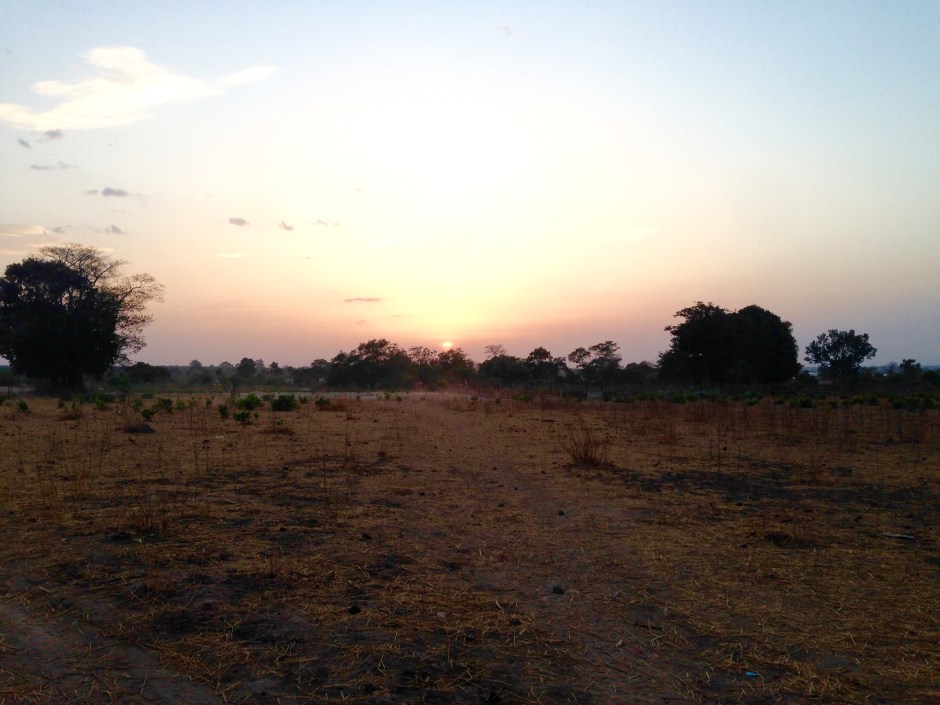
As I stepped off the plane in Banjul, I labored to quell the feelings of unease and discomfort roiling in my stomach. While gazing out over the sun setting over the dry grasses and baobab trees, I reminded myself to be thankful for this chance extended to me by such a reputable organization, and proud that I — little old Maggie with not much to her except a dream in her heart — had been successful in the intensely competitive selection process. It was then I remembered the mantra of one of my favorite adventurers, Chris Brinlee Jr., and frantically repeated it to myself in order to calm my anxieties about this venture: “celebrate discomfort.” To me, “celebrate discomfort” means to revel in the moments of discomfort — and indeed struggle — that navigating a foreign country and culture present, as such moments make one realize how they have been given such an incredible opportunity for self-growth and to do so while experiencing all the richly varied walks of life in our world. I believe that in this moment one can truly appreciate the beauty of adventure, and feel how great of a blessing it is to experience different cultures firsthand.
Yet I still could not ease the tightening in my chest.
During my time in my village, I threw myself into every possible experience. I practiced Wolof as often as I could, greeting each and every person I encountered on the sandy paths and appreciating their patient smiles when I stumbled over a word. I sat in my host family’s compound throughout the day, allowing the children to help me with my language homework and forging friendships along the way. I woke with the blushing sunrises and chased the great Gambia River on my runs, drinking in the alien yet starkly beautiful landscape of an African country yearning for the summer rains. Yet the harder I tried the more drained I felt, and I believe it is because I knew deep down in my heart that while I appreciated this country and its newness, it was not the place for me.
While I had lived abroad before and knew how to approach these feelings of homesickness and doubt, the type of living I had done in Scotland in no way prepared me for the bare-bones kind of living done in The Gambia. Though simplicity of life was what I had craved, in hindsight I was truly not prepared for this kind of living, no matter how intensely I had convinced myself otherwise. Deeply personal issues of mine reared their head every waking moment I spent in The Gambia and left me feeling anxious and numb. Perhaps years down the line, once I have experienced true living — the kind of living where usually mundane moments become an immense part of my day, and where every task becomes an endeavor — I may be prepared to embark on a journey of this kind. However, taking the leap from my cozy, quiet life in Scotland to the starkness of Gambian life was too much for me to bear.
These issues informed the most significant aspect of my decision to leave, and are something I have been struggling with every day since I have returned. Prior to my departure, I responded to all the comments about Third World living with a shrug. “It will be great,” I said, “I’m looking forward to being Internet free and getting back to basics!” How naive I was. What I was doing with comments like this was trivializing the fact that this is how The Gambian people live day in and day out, yet still manage to lead full and beautiful lives. I was taking for granted the fact that, after two years, I could simply trot back to my comfortable and struggle-free life in America. I was romanticizing their way of life and not taking into account just how difficult it would be for someone like me to adapt to that, as well as ignoring that that is their reality.
In hindsight, these are the kinds of discussions I had in my head in preparing myself to return home. I went round and round, warring with myself about being a failure that I could not handle this kind of living for a scant two years when this is what the Gambian people had to face for their entire lives. I chastised myself for craving the ease with which I did my chores, the restorative powers of running water, and the emotional comfort of being surrounded by my friends and family. Yearning for these things that I had taken for granted, and needed this sharp separation to appreciate, made me feel spoiled, and taking the steps to make my way back to them with my tail between my legs made me feel like a failure that I could not endure such conditions for a mere two years. It made me feel so sickeningly selfish that I could come and go as I pleased, while that was the reality for the Gambian people that had been so kind and welcoming to me.
However, what truly was the impetus behind my decision to leave was falling quite ill one Saturday morning. While the illness itself was nothing monumental — a mere stomach bug most likely caused by a change in diet (though it may have been due to my four-year-old host brother Baboucarr sticking his fingers in my mouth…) — and is a simple fix in the United States, it had the potential to become dangerous out in a remote Gambian village. I quickly became very dehydrated, and in the stifling heat of my small hut, my temperature bordered the degree that would cause the Peace Corps medical office to come and treat me. Yet the illness itself is not what ultimately convinced me to listen to my heart and ask to return home. As I have been abroad before, I am no stranger to navigating severe illness in a foreign country and taking care of myself when resources are limited and my support system is thousands of miles away. Furthermore, the illness I suffered was perfectly treatable on my own, and after hoisting myself out of bed, forcing (very disgusting) rehydration salts into my system, and fighting through my weakness to take a cold bath, I instantly felt better. Rather, it was the simple fact that I could not inform my loved ones that I had gotten sick and that, had I gotten worse, they would have learned about my condition from someone with the Peace Corps, and not from my own mouth.
When I would sit and enjoy the night sky with the Sohna family after our break fast meal, I observed just how intensely they valued their family time. One evening, my host mother asked me what my parents thought of me being in The Gambia so far away from them. While I had always believed I valued my family above all else, I realized in this moment that I had been incredibly selfish, for this path I believed I needed to take — that of the full-throttle adventurer — is a very lonely path indeed. Ultimately, the fact that I could barely even speak to my own family, especially to assuage their fears about me falling ill or that I was struggling personally, simply broke my heart.
Laying on my bed trying to recover my strength after my illness, I had an intense moment of introspection. I realized just how fortunate I was to have all that I have been given: I can complete my chores with minimal effort, I acquired a Bachelor’s degree from a world-class university and have no barriers to pursuing further education even though I am a female, I can run and exercise and enjoy the feeling of a healthy body, I have two parents that ceaselessly support every wild dream I have ever had, I have a collection of internationally diverse friends that have given me an incredible perspective on life, and I am loved by the most thoughtful and good man I have ever met. Yet I had run so very far away from it all in an effort to maintain this romanticized vision of myself I thought I needed to be. And while I ceaselessly berated myself for being a failure, I did the hardest thing I have ever had to do: simply accept that I did indeed fail this endeavor, and ask to return home. For, in the end, this decision was ultimately what was best for me and my health, and would also benefit the people that had been so sickeningly worried about me and my heart the entire time I was in The Gambia.
The most important thing to be said now, nearly three months later, is that I do not regret a minute of my time that I spent in The Gambia. There are moments in our lives where we need sharp contrasts, intense personal trials, and heartbreak to truly achieve a clarity of mind we had been previously unwilling to accept. This is what my time in The Gambia did for me: it made me realize that the way I was living my life was not truly authentic, that I was merely chasing a story rather than embracing all the moments that constitute living, even the ones that unfold ndanka ndanka. I celebrate this intense moment of discomfort in my young life, as it has taught me so much about the value of living, the value of family, and how to live life on my own terms. I will always cherish the moments I had sitting under mango trees, listening to the lilting Wolof tongue drift skywards with the sparks from the cooking fires. And while I have had to “turn at last to paths that lead home” to recenter myself and really work on what my priorities truly are — and cope with the fact that this journey was one of emotional strain but monumental personal growth — it does not mean I am truly willing to give up on my dreams of adventure.
From now on I will take my adventures at my own pace, but always keep the dream of seeing the sun from many a weird and wonderful new horizon alive.
Hello everyone!
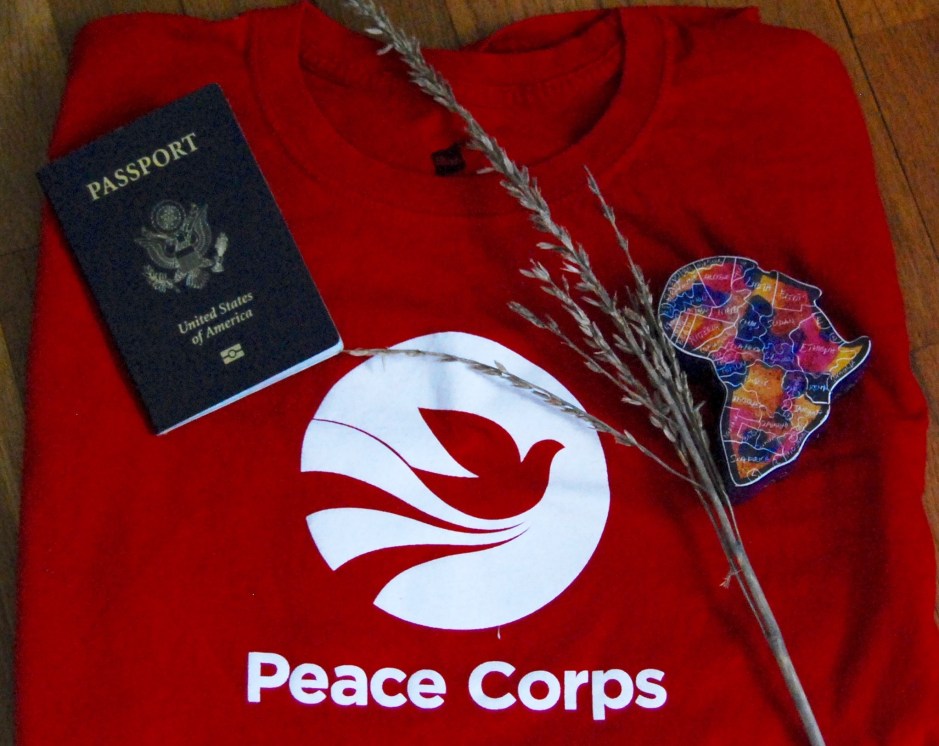
Apologies for the lack of updates. It has been an absolute whirlwind of emotions these past few weeks as I have finally received medical clearance to go to The Gambia.
On May 23rd I will be departing from Washington D.C. to begin the adventure of a lifetime. As tomorrow marks exactly one month out from making my way to staging in D.C., I will pen a more in depth post about all of what I am feeling at this moment, at the beginning of it all.
I would like to take this opportunity to thank each and every one of you once again for the tremendous amount of support over the years. It means the world to little old me, and makes up a great deal of why it is I do the things that I do and embark on the adventures I am so fortunate to have. Thank you!
-Maggie
When I awoke this morning it was not the nuthatch, finch, and chickadee songs coaxing me into wakefulness. It was not the early spring breeze, peaty and warm, billowing in my curtains, tossing back my sheets, and tangling in my hair. When I awoke this morning it was not a gentle awakening. What heralded today’s morning, what electrified all of my senses into wakefulness, was a panic attack. This is the first panic attack I have had since beginning my final semester at university nearly a year ago, and I almost forgot what these attacks felt like. Almost, but not quite.
I used to think that nothing could be as stressful as three critical deadlines (amounting to nearly 10,000 words written) within ten days. Or losing my luggage containing all of my underwear when I returned to St Andrews to begin my final year, and what kind of omen that represented. While I knew there would inevitably be challenges to adjusting to postgraduate life, I was actually looking forward to a respite from academia for a time and distancing myself from the stress that became my closest companion at university. I had no plan for my life after graduation, merely a vague “that way” direction. The details of this journey — the precise route, rough or smooth terrain, and whether I would have companions along the way — was something I did not care to mull over for very long.
My philosophy for approaching life after university was to be free spirited, laissez-faire. I vowed to simply laugh at any bumps encountered along the way and to repeat my new personal motto,”C’est la vie.” I was proud of myself for not having a concrete plan, as it meant that I had achieved a small personal victory: to relax and to not be so fixated on the minutia, as in the past when things did not unfold according to plan I would completely shut down. This new attitude also meant that I could commit myself to whatever weird and wonderful opportunity presented itself in my post graduate life, chasing new horizons and new experiences in the way that I believed I was meant to do.
What I had not considered in all this time was how not having a concrete plan could adversely affect me, and perhaps welcome back the stress I thought I had bid farewell with the stone walls of St Salvator’s Quad. As much as I like to appear a spontaneous, “go where the wind takes me” sort of individual, these wild-hearted traits are not intrinsic to who I am, but rather a conscious choice I make nearly each and every day. At my core I am organized and I am meticulous: as much as I have come to treasure the spirit of adventure, routine makes me feel calm and whole. This is why the uncertainty bound to my new life — the life of a newly minted yet wholly clueless graduate — began to chip away at me as summer slowed into autumn and autumn stilled into winter. For brevity’s sake I will refrain from rehashing all of the negative thoughts buzzing about my mind during this time, as I discussed them at length in my previous entry. All I will say is that the worries of wasting my time chasing dead-end dreams and anxieties of not being “enough” began to fade when the wildest of my “wild card” options — volunteering with the Peace Corps in The Gambia, West Africa — beckoned me to embark on the adventure of a lifetime.
Since graduating from St Andrews and accepting this invitation from the Peace Corps, the tone and content of this blog will shift to encompass the details and the spirit of my Peace Corps journey. This is why the panic attack I suffered as today’s morning alarm and its cause are significant. Though I hazard over-sharing, I aim to be truthful and to document all of my experiences along this journey: the good, the bad, and the ugly.
Last month I was told that I would not be granted medical clearance to serve in The Gambia. My Peace Corps journey effectively ended before it even began, and that certainty of purpose I was reaching for had vanished.
When I was in junior high, I had a teacher who intentionally failed me on several assignments. I gathered all the courage a twelve year old could muster and questioned him about his grading, for I was confused as to why I kept receiving such poor marks though I always answered questions correctly and exceeded curriculum expectations. He looked me in the eyes and said simply, “You need to learn how to fail.” At the time I was outraged. I believed that it was not his place to instill such a lesson, especially if his “teaching” reflected poorly on my transcripts, transcripts that I thought would determine my future. I also could not understand why success was something to be punished, especially in the context of a student-teacher, child-adult relationship. I wonder to this day why this teacher felt that discouraging the success of a bright child who is eager to learn was something he felt the need to do. And what this teacher perhaps never anticipated is how his “lesson” has stayed with me for over a decade later, and not in a wholly positive way.
Looking back, though, I realize that this teacher was right. Failure and I are not intimately acquainted. There have been moments in the past five years that felt very much like personal failure, and those experiences have admittedly been detrimental to my self-esteem. Yet I have learned from these moments how to be self-sufficient and strong, how to gather up my pieces, stitch them back together, and continue on the path I have laid out for myself. Most importantly, as I have gotten older I have learned that there is indeed a difference between mere disappointment and outright failure. So, this teacher was right; I do not fail often, mostly because the hiccups and roadblocks I have encountered in the past five years were not catastrophic, but merely moments of disappointment that encouraged self-growth.
I am relaying this story to you because this idea of learning to fail immediately came to my mind when I received word that I might not go to The Gambia. This was the moment that truly revealed to me the difference between disappointment and failure. Yet while the news has quite honestly devastated me, as the certainty of purpose that came with my invitation to go to The Gambia seemed to turn to ash in my hands as I read the reason for denying my medical clearance, it is not how this has affected me personally that makes me feel as though I have utterly failed. Rather, it is the thought of the teachers I will not be able to support, the children I will not be able to tell stories to, the community members I will not be able to befriend, and the experiences I will not be able to share with my friends and family that has me feeling like I have failed, for I have failed them.
One of my greatest ambitions in life is to live meaningfully, and I believe that the path towards doing so entails cultivating rich, diverse relationships across the globe with the goal of cross-cultural sharing and understanding. I believe that all of us have an integral role to play in the making of this kind of world; mine, so far as I know, is to tell stories about where I have been and the people I have the privilege to call “friend.” While this is not a world-changing or even life-changing part to play, I like to think that something as simple as sharing a story can indeed have an impact, no matter how small it may be. The denial of my medical clearance for the Peace Corps, and the ever-looming reality that I may very well not go to The Gambia thus makes me feel as though I have not fulfilled my duty, that I have failed the people that I know and those who I have yet to meet.
The panic attack that heralded my day was my response to a vivid nightmare about the Peace Corps denying my clearance I had in the moments prior to waking. In my dream, I was at a tribunal that would decide whether my appeal against this denial would be granted or not. No matter how ardently I pleaded, how persuasively I argued, the Nightmare Council would not grant my appeal and told me that the Peace Corps had no use for me. The stress of my waking life had finally infiltrated my dreams. The raw emotion I felt in the dream — the impetus for my “good morning” panic attack — emphasizes just how important my future with the Peace Corps is to me, and how desperately I wish to go to The Gambia to offer support in any way that I am able. And so I felt the urge to document my struggle with this turn of events, and just how it affects the purpose that I thought I had finally achieved.
Currently I am waiting to hear if the appeal I made to the Peace Corps medical board was successful. It is my hope that the letters of support from three physicians, in addition to a personal appeal I penned myself outlining my experience with the condition in question and my passion for service with the Peace Corps, will be sufficient to validate my case. However, I was warned that appeals are rarely granted, and even when they are, they often come too late. Several people have been asking me whether I am excited to begin this new chapter in my life and how it is I am preparing for life in The Gambia, yet the stress of this situation has made me mute. How can I be excited if this dream, a dream of a meaningful life, is slowly drifting away from me?
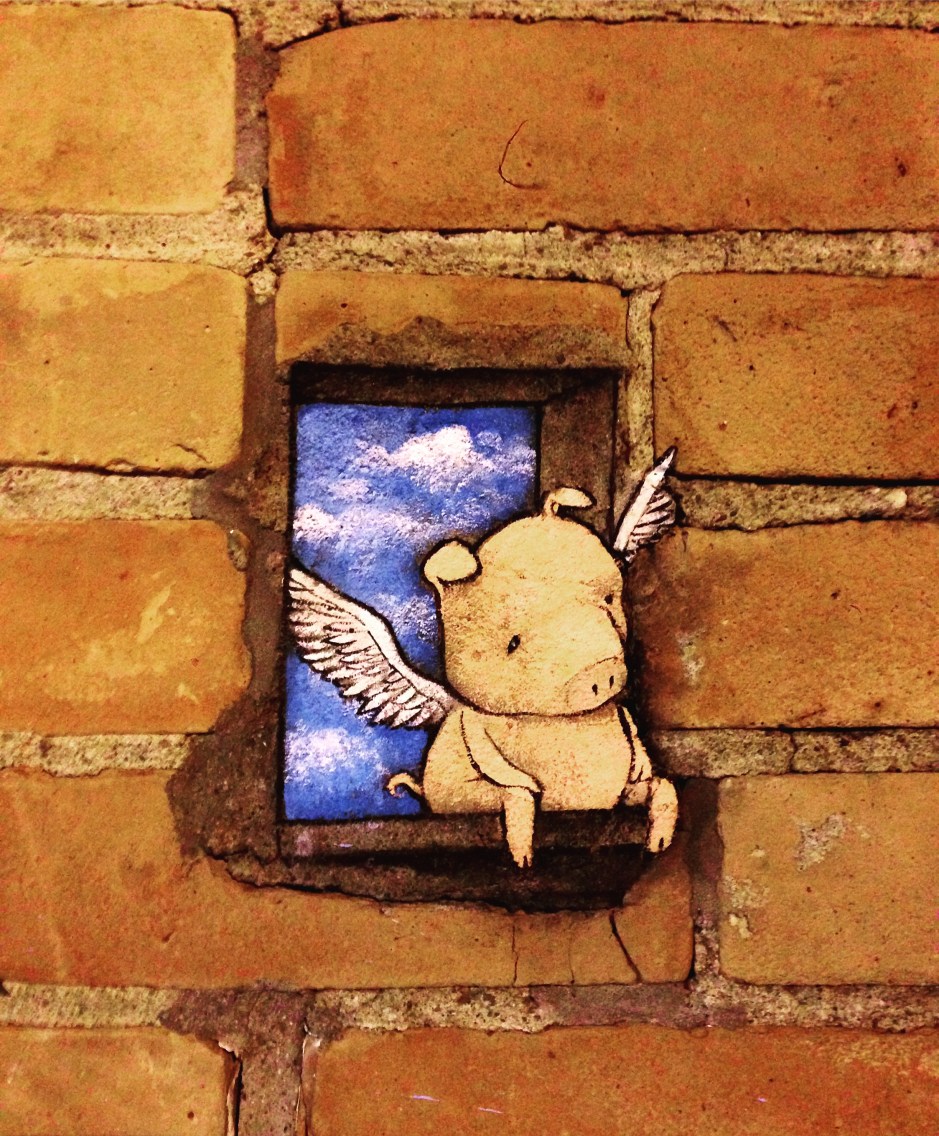
Lately I have found the idiom “when pigs fly” to be rather suitable for describing the current state of my life. With this news from the Peace Corps, it feels as though what I hope to accomplish in my life really will only occur “when pigs fly.” I have begun to think that I should not hope so ardently that my appeal will be granted and that I should strive to create more concrete contingency plans. Perhaps what I need to do is simply pull my head out of the clouds and acknowledge that I should be more realistic about the trajectory of my life and the goals I have set. And yet…
While wandering aimlessly around the city one evening, all of these thoughts muddying my clarity of mind and weighing heavily on my heart, I happened to glance up and see an illustration of a small winged pig sitting dreamily on a ledge, a beautiful blue sky to his back. Much like the message in my chocolate telling me to go to The Gambia in the first place, I am a firm believer in the universe sending us little reminders of what it is we are meant to do when we are unsure of ourselves. The wee flying pig that I saw that night seems to me that the universe has given me a sign to keep hope alive.
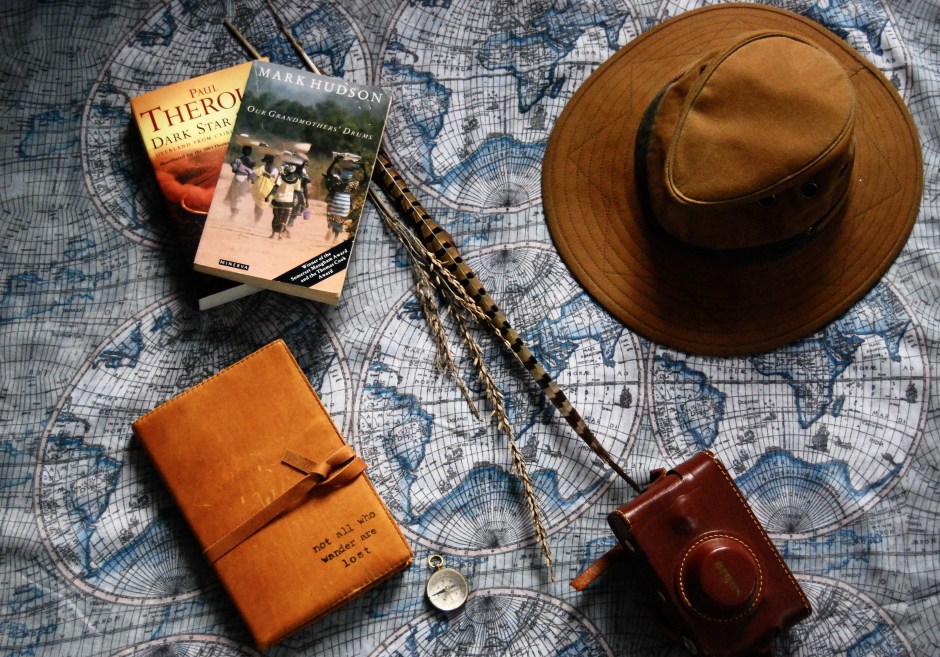
Misneach – An Irish word meaning courage
————————————————————————–
Surrounded by songbirds lamenting the waning warmth of summer and with a steaming mug of coffee by my side, I settled down to read Brian Doyle’s The Plover one crisp September morning, not really knowing what to expect. Doyle’s hero Declan O’Donnell, narrating from an erratic and darkly humorous stream of consciousness, chases the endless horizon of the Pacific. The aim of his voyage: to escape civilization and in some ways himself. Yet much like our own lives his journey does not unfold as intended, as a small nation of misfits and eccentrics accompanies him aboard The Plover.
The word misneach resounds throughout the novel like a chorus, serving as Declan’s modus operandi while he struggles to overcome his own weaknesses and loneliness. As my eyes flitted over this word and took in Declan’s interpretation of its meaning — “don’t drown, stay with the ship” — I felt as though I had been turned inside-out.

During my time as a literature student I spent countless hours chipping novels away to their bare bones. I find myself more critical of contemporary novels as a result, and it is rare that I find a book that grabs me by the soul and commands my greatest attention. Yet Doyle’s The Plover did just that, leaving me utterly captivated. When we unexpectedly stumble upon a novel, a film, or a piece of music that resonates with our circumstances at that time — or seems to understand the most hidden parts of ourselves — it is in these moments that I believe in Fate. The Plover struck me so keenly because with the meandering and maddening voice of Declan, Doyle effectively captures what it feels like to be rudderless. And that is exactly what I was: adrift.
Like a plough horse — whose whole existence is focused on hard work and driving relentlessly for a goal — cannot cope with idle ease, I too was restless and upset without something to work for. I had no goal to strive towards: no job prospects despite my education and enthusiasm, having to defer my graduate school plan as a result, and living each day 3,000 miles away from my closest friends. I began to doubt myself once more, questioning whether the goals I had set for my life were too grand, too fantastic for someone like me.
It was around this time, misneach quietly drifting through my mind like a whisper, that my mother suggested I apply to join the Peace Corps. I recalled a very keen desire to do so in my early teen years, devouring any book I could get my hands on about the volunteer experience. Yet in the wild turn my life had taken during that time — deciding on a whim to move to Scotland for university — I had all but forgotten that serving others had once been a great ambition of mine. A small, fragile shaft of light began to creep out from behind the clouds I had been under. While I have never volunteered before, I began to see the Peace Corps as a way to not only rekindle this love of helping others, but to marry it with my passion for international travel and learning firsthand the intricacies of another culture nurtured during my time in St Andrews. But most importantly, it was the opportunity to have a purpose once more.
So I diligently worked on an application, yet not without trepidation. The doubt that had plagued me throughout the summer — the doubt that told me I was not good enough to live the life I dreamed — lurked over my shoulder as I agonized over my mission statement. Why should such a reputable organization like the Peace Corps accept me: a person with little career experience, a person who only knows how to be a student, and a person who has never done anything as adventurous, daring, and selfless as this in her life?
Once again I was proven wrong. On November 29th, 2016, I received my invitation to serve as a teacher trainer in The Gambia, West Africa beginning in May 2017.


In the beats before opening that letter I felt my little heart steadily slow until I was unsure of whether it was truly beating. Much like my acceptance into St Andrews, I believe this moment will be seared into my memory as a day in which my life changed irrevocably. Unlike St Andrews, however, I did not feel the same heart-bursting and soul-lifting joy. I ascribed this hesitance to several benign excuses cluttering my thoughts: “I truly wanted to serve in Mongolia and not The Gambia, where even is The Gambia, it is probably too hot in West Africa for a Michigan-born and Scotland-raised girl like me, and do I even have the skills necessary to be an effective teacher trainer in the first place?”
Yet I began to realize how all of this empty postulating and excuse generating was merely done to bury the true issue at hand. The more the rejection emails, the loneliness, and the absence of direction in my life weighed on my heart, the more I regressed into the person I was; the person I vowed I would never be again. In resettling myself into my armchair, surrounded by my books, I had chosen comfort and safety over living a full life: dirt and all. Rather fortuitously, I had fished a Dove chocolate out of the wee bowl atop my mother’s work desk, as I had been wandering the city for the day and had returned for that fateful interview the hour prior. Dove chocolates are known for their cute and uplifting messages written on the underside of the wrapper, silly and meaningless in any other circumstance. The two words scrawled on my wrapper, however, stopped my heart completely.
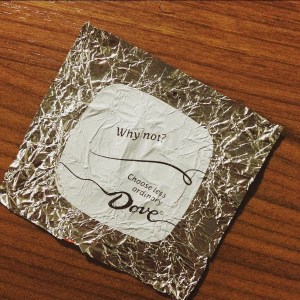
With these words in my palm and misneach ringing in my ears, I knew then what I had to do.
In four months I will be off to Washington D.C. for the staging event, then I will board a plane destined for a country I could never have foreseen myself traveling to, much less living in. The next two years will be spent amongst heat and dust; I will most likely be without electricity and running water, and I will be even further out of contact with my friends and family than I have ever been. Am I scared silly? Yes. Do I regret my decision? Not in the slightest; misneach, after all.
The thought of being an enthusiastic and supportive teacher trainer yielding a positive impact on the community in which I am placed serves as a balm for my doubts and fears. However, it is what the Gambian people may offer to teach me regarding their history and their culture that truly excites me about the years to come, and makes up the heart of my motivation to serve as a Peace Corps volunteer. To teach and be taught in return: this reciprocal relationship and educational opportunity beyond my books or the university class strikes me as one of the most enriching aspects of the Peace Corps experience, and speaks directly to my curious and passionate soul.
As J.R.R. Tolkien wrote in The Fellowship of the Ring, “All we have to decide is what to do with the time that is given to us.” Deciding to accept this invitation from the Peace Corps and commit to living a life so unlike any I have ever known will amount to the most courageous thing I have done to date. However, what it is I wish to do with the time I have been given is to learn, to love, and to live meaningfully. So cheers to new adventures and to the beginning of chapter two.
Three days ago I met someone new; an experience which, for me, hums with possibilities. What has this person seen in their life that I have not, or what inspiring stories might they have to tell? Questions such as these course through my mind each time I get to know someone. Regardless of who they are, where they are from, or that meeting new people is an everyday occurrence, I am grateful to listen to every person’s story.
Every once in a while, though, someone casts a dark cloud over this simple experience. The person I met a few days ago did just that. Perhaps I feel compelled to express these thoughts since what this person said truly had power over me, the power to make my fragile joy crack and splinter, in light of my current circumstance.
As many of my close friends and family know, maintaining my “Post Grad Plan” has become akin to bottling the wind. Nothing has worked out as I thought it would: I have been rejected from every job I applied to, even part-time positions at retail stores and coffee shops. Each and every rejection, every “you do not have the skills or qualifications necessary for this position” makes me feel worthless. Not only this but since I have been unable to secure a job in my time away from university, the possibility of not beginning my Master’s degree next autumn is slowly becoming a reality I do not want to face. And with the ocean separating me from the land and people I have grown to love so much, these difficulties seem even harder to bear. To be frank: I feel empty, upset, and alone, and wish nothing more than to be back in the United Kingdom living my ambitions with my closest friends a mere train ride away.
This is why what this person said to me stung so keenly. Over the course of our conversation, where I went to university and what I studied inevitably came up. When I explained that my degree was in Comparative Literature and English, she primly replied, “Oh good for you. So do you want to be a barista?” Too stunned at the condescension pouring out of her mouth, I merely stood there spluttering while a smug smile lit her face.
In hindsight, I wish I had fired back with an equally demeaning statement to make her realize just how rude she had been to me, a total stranger. However, as this woman was over the age of fifty, standing up for myself would most likely have confirmed her suspicions that I was indeed a rude, self-absorbed, and entitled millennial. From my perspective, her compulsion to say these things as a subtle yet deliberate insult is perhaps the very soul of the word “entitlement”: feeling as though you are in a position of power over someone else to say and do things without regard for the consequences or how that may negatively impact another person.
Where I come from — the land of lawyers, doctors, and engineers — asking someone if they want to “be a barista” is intended as an insult, an insult usually leveled at liberal arts majors. The thought behind this sentiment is simple: liberal arts majors are incapable of making a “successful” life for themselves and are only destined for either unemployment or “menial” work such as making coffee.
I found myself questioning what is actually wrong with being a barista. Baristas often make someone’s day by providing them with the perfect cup of coffee. Local coffee shops also serve as an important thread in the fabric of a small community. There is something very comforting about having a barista make your coffee exactly the way you like it or them knowing what is going on in your life. This, to me, is what it means to be part of a community. To wield the word “barista” as an insult detracts from these feelings of comfort and community, as well as putting down those who have the power to improve a person’s day with something so simple as serving coffee with a smile.
Furthermore, what this person did not know when speaking to me is that I cannot even be hired as a barista in the first place. I have applied to several jobs that this person would deem “menial” — though appropriate for that silly liberal arts degree of mine (sarcasm intended) — and was considered unqualified for all of them. If I cannot even be hired as a barista, which in her mind was a subtle insult to my choice of degree, how does this help the feelings of worthlessness that are now part of my everyday life? The staggering amount of rejection I have faced in the past months has taken an immense toll on the self-esteem I worked so hard to rebuild. The pride I felt upon graduation seems like a dream. Negativity of this kind astounds me, as I believe that the ambitions of the younger generations should be encouraged and supported by those who have the benefit of living long and successful lives.
However, I am no stranger to receiving subtle insults and veiled attacks regarding the path I chose for my life. What I find strange, though, is that others often feel so compelled to voice their negativity when faced with my determination and passion for the kind of life I want to lead. As I am currently in the midst of one of the most intense transitions in life — that seemingly endless void of inactivity between university and the “real world” — I felt that it was time to begin collecting my reactions to these criticisms endured over four years. What this person said to me was simply the catalyst for putting them to words on this blog.
I also realize that the criticism and negativity regarding what I’ve studied, where I went to university, and what I want to do with my life will not end. So instead of dwelling on the subtle hurt this woman may have intended, I have decided that her words are merely more fuel for the fire. To every person that has ever sneered, “Why?” or, “What are you going to do with that degree?” or even outright deny me of success based on my passion as this person did, and to all those who will do so in the future: thank you. These are the people I will remember when I am feeling as though I have no worth in the industry I desire to work in, or when I have hit a creative slump with whatever project I am working on at the time. What these people do not know about me is that telling me what I cannot do only makes me work that much harder to prove them wrong.
So here’s to pursuing ambition as passionately and determinedly as possible.
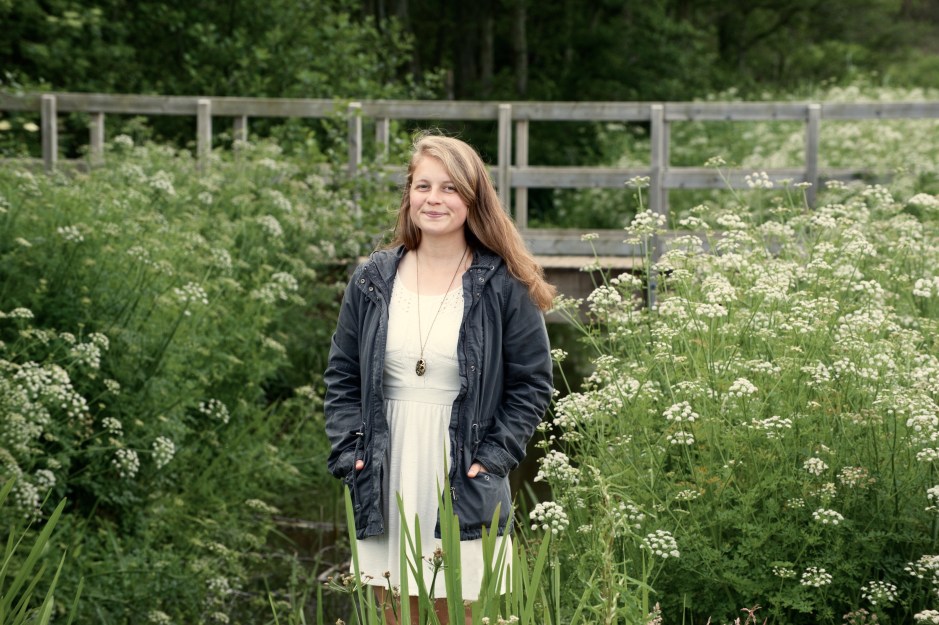
In the moments between sleeping and waking, petal-thin and fragile, I hear the whisper of the sea. With eyes closed I am treading across the beach of West Sands, bare feet memorizing the grooves etched into the sand. I am content. Yet when I open my eyes gossamer curtains drift lazily into view, and the damp, earthy aroma of slightly burnt coffee fills my senses. For the past month I have begun each day this way, confused, momentarily unable to recognize where I am or recall what has happened. And as more days pass, the more my time in Scotland really does seem like just a dream.

Before I packed my suitcases and made that voyage across the sea for the first time, envisioning myself at St Andrews was indeed just that: a dream. Like many teenaged girls, I was uncertain of myself and what course my life would take, so much so that I was well-known for being very timid and shy in nature. And while this is difficult to admit on a forum such as this, there was little that I took pride in or even liked about myself. By my final year of high school I was so desperately unhappy that I almost could not face each day. What made this experience more painful were the constant reminders of the person that I was, the person I had lost. Gone was my love of storytelling, the simple pleasure of cold wind caressing the skin, and the feeling of always being on the verge of discovering some other world. I had lost the joy that was once so intrinsically a part of me. The summer before my final year of school I saw myself turning down a path that I knew I could not escape if I chose to follow it: attending university close to home, perhaps even living at home with my parents, never seeing the places and accomplishing the dreams I once treasured, and thus growing up to be but the hollow shell of Maggie. Yet despite this, still waters do indeed run deep as the saying goes, and I felt the irrepressible impulse to take drastic action. It was then that my mother sent me photos of St Andrews, and warmth slowly began returning to my heart.


I distinctly remember an incident with my high school guidance counselor that cast a shroud of doubt over this secret ambition I nurtured. Final year students were expected to attend three meetings with their guidance counselors throughout the year to discuss what universities they had applied to, where they had been accepted or rejected, and which university they at last decided to attend. When I revealed to this woman, someone I had had no relationship with throughout my four years of high school, that I desired above all else to attend St Andrews she had the audacity to scoff at me. She then suggested that I “do myself and my family a favor” and pursue a “more realistic” course of action, stating that attending university abroad would waste my parents’ money, that literature was a worthless pursuit, and that I would only get rejected by St Andrews and be crushed by that outcome. Even when my acceptance arrived one chilly November morning, indelible proof that I had earned a place at such a university, her harsh words infected what little self-confidence I possessed.
As my heart is not only worn on my sleeve, but welded there, her denial of my academic abilities continued to plague me throughout my first year at St Andrews as well. Each time I sat completely dumb in a tutorial and each mere “pass” I received on my coursework had convinced me that not only my guidance counselor, but the many other naysayers I accrued, were right: that St Andrews would devour me whole.


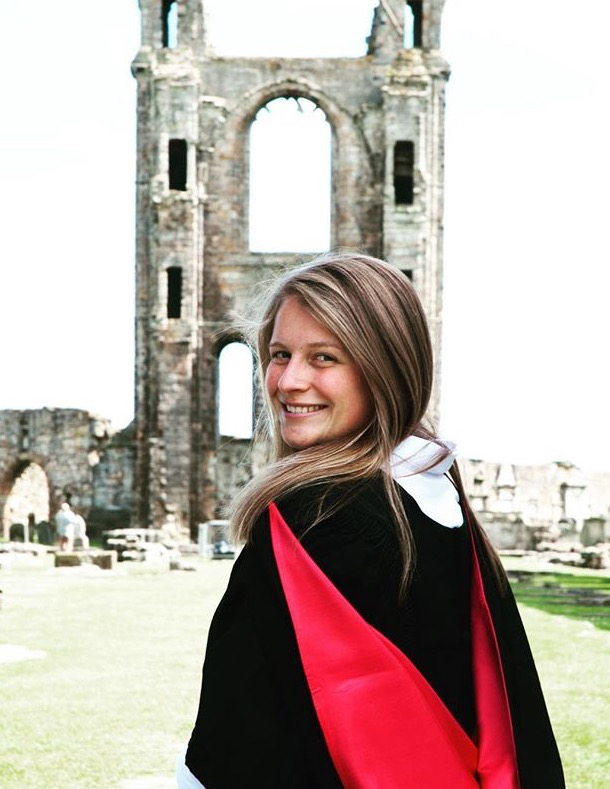
However, on June 23rd, 2016 I proved them wrong. On that day I graduated from the University of St Andrews with a high 2:1 in Comparative Literature and English, even earning a place on the Dean’s List for my work during the 2015-2016 academic year. Yet what surprisingly pleases me more than these results are the commendations I received for my dissertation, a piece of work I had convinced myself was in no way academic or even worthwhile. Hearing my supervisor — a woman who intimidated me significantly with both her intellect and her sheer presence — praise my work with genuine enthusiasm brought tears welling in my eyes. While revealing these details could be construed as a slight boast, those who know me well are familiar with my utter aversion to speaking positively about myself or what I am capable of. However, I believe that it is important to voice these accomplishments in words, and indeed recognizing them as such: achievements. In hindsight, what this recognition has made me realize is that perhaps the most powerful critic that I had to overcome was myself.


My time at St Andrews and in Scotland means so much more to me than academic achievement, though. In a strange way, I had not really factored in the people I would meet and the friends I would make prior to starting university. The beauty of Scotland and the opportunity to carve my own path was what drove me to this place; friends, if they came at all, would simply be a ripple effect. This strange mentality is the very vicious offspring of the self-doubt that has troubled me all these years. I simply wondered why anyone would actively seek my company, for what positive thing could I possibly contribute to a friendship? I remember dissolving into tears during Fresher’s Week because I wholeheartedly believed that I would spend the next four years completely alone in a foreign country, and I lamented the choice I had made. My mother assured me that I would find “my tribe,” as she put it: a raucous band of quirky individuals who shared my passions and my off-color sense of humor, and would most importantly accept me for all that I am. Four years later, I sat in the same restaurant celebrating my graduation and felt a similar rise of emotion. This time, though, it was because I did not want to leave “my tribe” behind.
Running through the thicket of Lade Braes with Daniel, iced lattes and scones at Gorgeous with Miranda, sitting at the top of the world with Molly and Kate on the Isle of Skye, and wandering aimlessly along the looking-glass waters of West Sands with Catriona: moments such as these fill me to the brim, and are truly what make my time in Scotland worthwhile. Sitting here back in Michigan, safely tucked in my armchair and amongst my books once more, I feel very much like Bilbo Baggins when he returns at last to Bagend, to the quiet and the solitude. There was a time when this was all I wanted, to be home again. But now I find it lacking, as though a piece of my soul has gone missing. There is nothing I would not give to experience one of the aforementioned memories one more time, to be amongst those weird and wonderful people feeling so welcomed and loved.


At times I think back to the girl I once was, all corn-silk hair and bruised knees, who loved nothing more than to be covered in dirt from chasing fairies through the forest. To an extent I believe that who we were as children is the essence of ourselves, that the one defining characteristic we had then will follow us through the rest of our lives. While we may experience circumstances that harden us, that make us drift apart from who we once were, I think that everyone needs a moment in their lives to reclaim that essential part of themselves. And I do believe that I have grown significantly since childhood, and indeed since I first began university; I am a bit wiser, more responsible, and more attuned to how the world at times does not live up to our rose-tinted expectations. However, since coming to Scotland I do feel closer to that little girl, in the sense that I have rediscovered what it means to be enchanted with life. Whenever I would set foot on Scottish land, I always sensed this subtle feeling, a kind of pulse coursing through the rough grey stone underfoot. Teeming, I call it. It is as if I could take a hammer and chisel to the jagged seaside cliffs, chipping away the stone to reveal an incandescent world underneath. While such thoughts may be inspired by the fairy tales I once read, the memory of the frigid winds caressing my skin and sea-brined air in my lungs has me feeling this teeming in the marrow of my soul.
On a jaunt to Edinburgh with Molly one day I discovered a poem by Sir Alexander Gray engraved in the stone of the Parliament Building. One stanza in particular resonated deep within my bones:
“This is my country,
The land that begat me.
These windy spaces
Are surely my own.
And those who here toil
In the sweat of their faces
Are flesh of my flesh,
And bone of my bone.”
It is important to recognize how throughout this post I have not referred to Michigan as “home.” Never before have I felt more at home than in the years I spent in Scotland, for it is the place that I truly belong. While in Scotland I was able to learn how to take pride in myself and rediscover all of the qualities that are intrinsically Maggie: I am a bit more whimsical, a little reckless, and altogether wilder than I have ever been. Yet that is who I am, and more than anything I am grateful for the time I had amongst the lochs and glens, hills and seas of Scotland to help me find that part of myself. More than anything, though, I am truly awed and humbled by those whom I had the pleasure to call friend over the last four years, for they have indeed become “flesh of my flesh, and bone of my bone.”

While I am beyond words to express my gratitude to have had this experience and for all the people I came to know, the pain of leaving it all behind is still visceral and raw. To put it simply, I am devastated to no longer live in Scotland. And try as I might to assure myself that my departure was not my last goodbye, a small part of me still worries that I may never return. However, I believe that the most crucial lesson my time at St Andrews has taught me is to keep pursuing adventure and to find the joy in each and every experience I have, no matter the circumstance. While my last glimpse of Scottish soil was misted by the hot tears I could not quell, there is a positive to the situation. My wanderlust is now more insatiable than it has ever been before, as I have had this single delicious drop of adventure. The direction of my next horizon as yet remains a mystery, however, I am confident that I will never stop exploring; something Tookish has awoken in me indeed.
Yet in the words of Robbie Burns, “Wherever I wander, wherever I rove, the hills of the Highlands for ever I love.” If anyone so wishes to go looking, my heart and soul are forever in Scotland.
At times I wonder why it is our mind clings to memories of painful, sorrowful, or even shameful experiences in our lives. The first week I spent in Scotland as a first year St Andrews student has remained strong and coarse in my memory, like a weed you cannot seem to eradicate from an otherwise pristine garden. At the time I felt as though I had made a grave mistake to move so far from home, away from the comfort of the life I thought I should be leading. I had quietly resolved to myself that I would stick out the semester then beg my parents to let me reconsider my choice of university. Each time I saw my parents I fought back the emotion that was clawing its way up my throat: the fear and loneliness that comes with being the farthest and longest away from home I had ever been. In hindsight, I am at times ashamed that I did not appreciate this opportunity as fully as I should have.
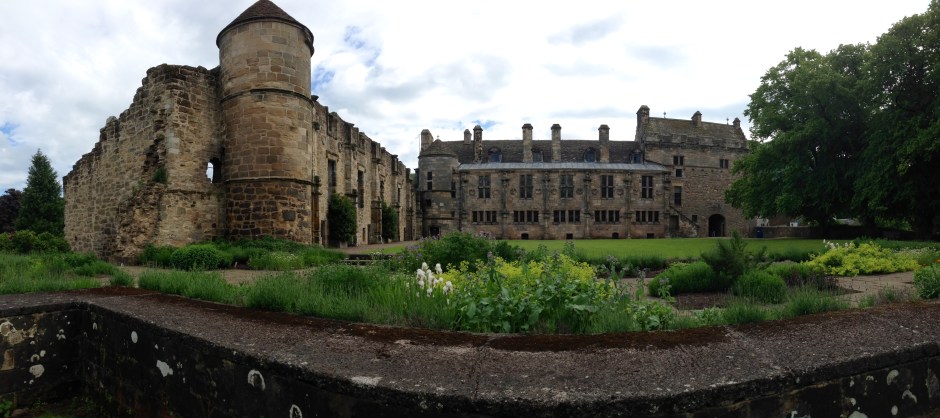
Four years later I sat waiting at Haymarket station to surprise my parents after six solid months apart, the longest time I have ever spent away from them. The emotions coursing through my veins drew their substance from an entirely different source. While I was excited for their arrival — especially since neither had traveled to Scotland in over a year — it was an altogether bittersweet reunion. Their presence made the end to my time in Scotland a living, breathing reality. In the days following their arrival I would officially graduate from the University of St Andrews, give my closest friends a final embrace at Graduation Ball, and gaze wistfully out over the North Sea one last time. Sensing my distress about these events, my mother suggested day trips to Falkland Palace, Doune Castle, and the Highlands for their last Scottish adventures. Not only did she and my father wish to see these places, but to be amongst my favorite things — the starkly beautiful hills of the Highlands and mysterious castle ruins — one last time was a welcome distraction from what was to come.
As Scotland is peppered with castle ruins and palaces, you might find yourself asking just why Falkland Palace and Doune Castle made the cut as the last two I would visit. Lately my mother and father have become engrossed in the Outlander television series, and both the village of Falkland and Doune Castle provided locations for the show. And I will not lie, I am also rather smitten with the tales of peril, romance, and adventure found in both the Outlander novels and television series. So I could not object to my mother’s determination to visit these places, and was eager to explore these new places that were so close to me.


In Outlander, with the help of some very talented people, the village of Falkland in Fife transforms into 1940’s Inverness. Having traveled to Inverness two years ago, my father and I chuckled at the contrast. Despite the lure of both Falkland Palace and its new Outlander-bestowed fame, Falkland remains a sleepy little village at the base of the Lomond Hills, about twenty miles southwest of St Andrews. After a very Scottish lunch of salad topped with black pudding for me and my mother and a haggis panini for my father at Campbell’s Coffee House and Eatery, we wandered through the wee shops of Falkland. The rough exposed stone in the interior of the shops and Scotch wool blankets galore had my parents swooning, and more than once the words, “I could live here” escaped their lips.
For 200 years Falkland Palace served as the country residence for the Stuart Monarchy. While the rich history is initially what draws me to Scottish castles, it is the quirky, lesser known details that really capture my attention. For example, Falkland Palace is said to be the home of the oldest tennis court in Britain, built for James V in the sixteenth century. Instead of trinkets and baubles from gift shops I have begun collecting these little tidbits of knowledge, perhaps because I simply just love to learn. After touring about the palace we moseyed out into the gardens. Hidden amongst the immaculately kept flower beds were crumbling stones and depressions in the grass, ghosts of the original twelfth century hunting lodges that once stood on the property before Falkland Palace.
With the sun blushing a brilliant red on the horizon we felt that it was time to leave Falkland. As the Lomonds waned behind us I reflected how glad I was I had made this journey, since during term time I have a tendency to forget not only Fife’s deep history rooted in sites like Falkland Palace, but also its contemporary relevance as evidenced by its significance for cultural products like Outlander. And as I heard my mother and father praise Falkland endlessly, I realized on this trip how fortunate I was to live in a place like Fife, so full of quaint and unique villages as it is. Yet the true highlight of this “Graduation Tour” was still to come.
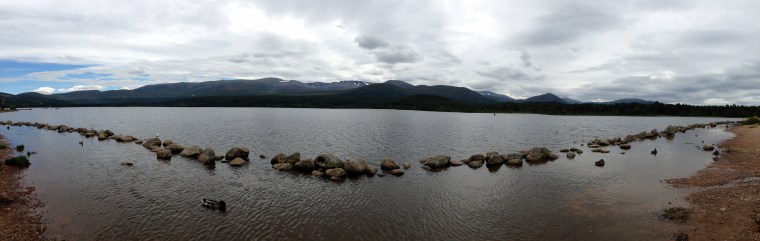
The Sunday after Graduation Ball had me up and out of the door a scant five hours after the closing fireworks winding along rough Highland roads. While my father had the opportunity to explore Loch Ness and Drumnadrochit with me two years ago, my mother had never strayed beyond the bubble of Edinburgh and Fife. Though I was keen to return once more “to the waters and the wild,” I was more excited about accompanying my mother to a place that for so long had been just a dream to her. We also had a very specific goal in mind besides simply reveling in the majesty of the Highlands: the Cairngorm Reindeer Farm. I am a lover of all animals, but I have a special tenderness for the goofy and the strange. And for many people, a reindeer may undoubtedly match that description. When I learned that there is a herd of reindeer right in the heart of Scotland, I knew I had to visit. With the banks of Loch Morlich guiding us to our destination, we wove our way through Glenmore on a quest to fulfill this “bucket list” adventure.


Throughout my parents’ stay in Scotland I kept remarking how lucky they were to be welcomed by only brilliant sunshine and warm breezes, despite the weather channel warning otherwise. True to form, however, Scotland decided to show its true rainy self on the one day we would spend entirely outdoors. So, we found ourselves hiking through a verdant Highland forest under a thick blanket of ashy mist, yet this did nothing to dampen our determination to meet these reindeer. At the top of the small hill our guide suddenly let out a rolling bellow from deep within her stomach. Dozens of reindeer with all manner of colors, antler patterns, and sizes began to emerge from a hidden valley in the distance, and my heart soared.


Reindeer are surprisingly lazy and greedy animals, their sole passion in life being for food. The herders heaped large portions of special reindeer feed into our cupped palms so that we would instantly make our way into the reindeer’s good graces. I had no problem with the multitude of small, fuzzy bodies crowding around me and could not help but giggle as frenzied lips tickled my outstretched hands. And while I have spent most of my life around horses, which are much larger than reindeer, I was a tad nervous about the number of large antlers swaying and swinging right into my face. Once a majority of the food in my hand had been lapped up many of the reindeer surrounding me quickly lost interest. However, the wee black fellow pictured above proved to be a tender soul, as he stayed to lick every last fleck of grain from my hands. He even began to follow me around, and at one point when my back was turned, gently tugged on my backpack to get my attention. I was completely smitten.
Thoroughly soaked through by the needling summer rain, my parents tried coaxing me to come back down from the hill. I think they were concerned that once I befriended a reindeer I would leap on its back and gallop deep into the Highlands, never to be seen again. And I will admit, there were moments in my growing bond with the little black reindeer that I considered becoming the Wild Scottish Reindeer Hermit. Looking back, I sometimes wonder whether I imagined the whole experience, as frolicking through the Scottish heather and mist with such majestic creatures seems to belong in one of my vivid fantasies. The very existence of this little herd has only strengthened my belief that Scotland truly is another world, a place where magic comes to life and waits to be discovered by those who dare to go looking.


Our final wee day trip, and one of my last full days in Scotland, was spent exploring Doune Castle. When most people are asked to picture a Scottish castle, the picturesque Eilean Donan usually comes to mind, and I do not exempt myself from that. To my surprise, Doune Castle is arguably as recognizeable as Eilean Donan, Urquhart, or Edinburgh… if you ken your pop culture, that is. Similar to “that actor or actress” who seems to appear in every film or television show despite never knowing their name, Doune Castle has quite the resume in the film and television industry. Doune Castle serves as Winterfell, the stronghold of the stoic House Stark in Game of Thrones; Castle Leoch, the seat of Clan Mackenzie in Outlander, and appears in Monty Python and the Holy Grail. If truth be told, though I am a self-proclaimed epic-fantasy buff I was completely oblivious to all this activity unfolding at Doune.


Initially I was a bit off-put by the Outlander and Monty Python paraphernalia cluttering the ticket office. While we were admittedly visiting Doune because of it’s appearance in Outlander, I think the urge to be commercially brazen about it’s association detracts from what intrinsically makes the place. For example, I found the grounds of Doune Castle to be one of its most fascinating qualities. After growing accustomed to the pristine gardens of Loseley Park and Falkland Palace, the overgrown and unkempt grounds was a stark contrast. Yet I was mesmerized by it all: the moss-bidden stone wall hidden deep in the forest, the wee grass footpaths dotting the land, the river burbling away under a canopy of emerald leaves. While sitting pensively on a boulder in the river I half expected the ethereal women from the “Dance of the Druids” scene in Outlander to pass silently amongst the trees beside me, a treasure from Scotland’s enigmatic past. These delights proved that despite its fame, Doune still had a bit of wildness to it, preserving that untamable and magical spirit I feel is coursing through the veins of Scotland.
Perhaps the most special thing about all of these trips is not how grand in scale or adventurous in spirit they were. Rather, I think what I have come to love most about my time in Scotland is the chance to show this land I have fallen so in love with to the people that are important to me. The chance to share the magic and sheer wonderment I feel about Scotland each and every day with my parents, in particular, is something that I treasure, mostly because they encouraged me to embark on this adventure in the first place.
And though with each day that passed my sadness about leaving Scotland grew, seeing the joy that I constantly feel bloom in my parents’ eyes as they took in these sights eased my sorrow. I know that years in the future these last moments spent in Scotland with my parents will still be kept close in my heart. Not only for the sense of wonderment we shared, but also because they finally got to witness the transformation this journey has wrought in me: that Scotland is well and truly the place I belong.
 Maggie Sadler